Archives
-
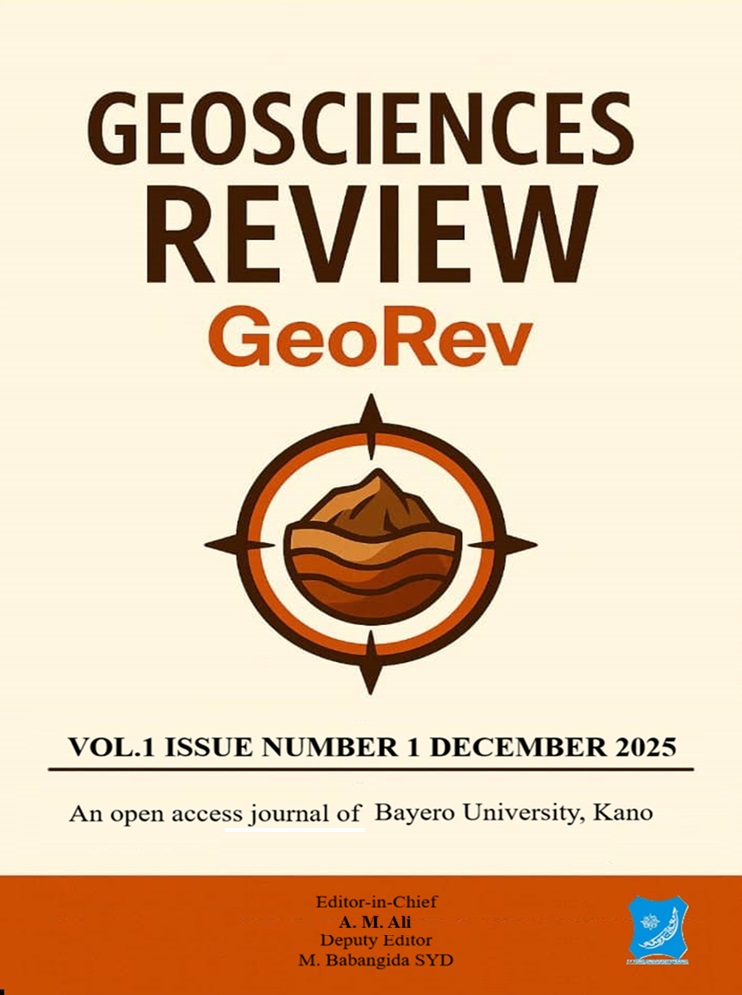
Geosciences Review - Vol. 1 No. 1
Vol. 1 No. 1 (2025)This is the maiden issue of Geosciences Review, an Open Access journal of Bayero University. Kano
Geosciences Review (GeoRev) is a peer-reviewed, open-access journal of Bayero University Kano, dedicated to disseminating high-quality research and critical reviews across all areas of geosciences. The journal provides a platform for scientists, researchers, and practitioners to share discoveries, innovations, and case studies that advance our understanding of the Earth and its dynamic systems. GeoRev welcomes original research articles, comprehensive review papers, short communications, technical notes, and case studies across diverse sub-disciplines, including but not limited to sedimentology, hydrogeology, environmental geology, remote sensing and GIS, petrology, structural geology, geochemistry, and climate-related geosciences. With a focus on both regional and global perspectives, GeoRev aims to foster scholarly communication and promote research that informs sustainable development, resource management, and environmental stewardship. Contributions from academia, government agencies, and industry are equally encouraged.
-

Geosciences Review - Vol 2, Issue 1
Vol. 2 No. 1 (2026)The subsurface thermal structure of Gombi North and environs in northeastern Nigeria was investigated using aeromagnetic data obtained from the Nigerian Geological Survey Agency. The study aimed to estimate Curie point depth, geothermal gradient, and heat flow, which are essential parameters for assessing geothermal energy potential. Data were processed using Oasis and MATLAB, and total magnetic intensity data were subjected to upward continuation to eliminate shallow anomalies. Spectral analysis was then applied to determine the depths of the top boundary and the centroid. Results showed that the depth to the centroid ranges from 9.15 km to 12.10 km, with an average of 10.49 km, while the Top Boundary depth ranges from 4.79 km to 5.56 km, with an average of 5.32 km. The Curie point depth ranged from 13.51 km to 18.64 km, with an average of 15.65 km. These values correspond to geothermal gradients of 31.12-42.93°C/km, with an average of 37.53°C/km, and heat flow values of 77.79-107.33 mW/m², averaging 93.88 mW/m². The findings suggest that blocks 2 and 3 exhibit favorable geothermal conditions, highlighting their potential for geothermal energy development in the region. This study provides valuable insights into the subsurface thermal regime and supports exploration of renewable energy resources in Northeastern Nigeria.